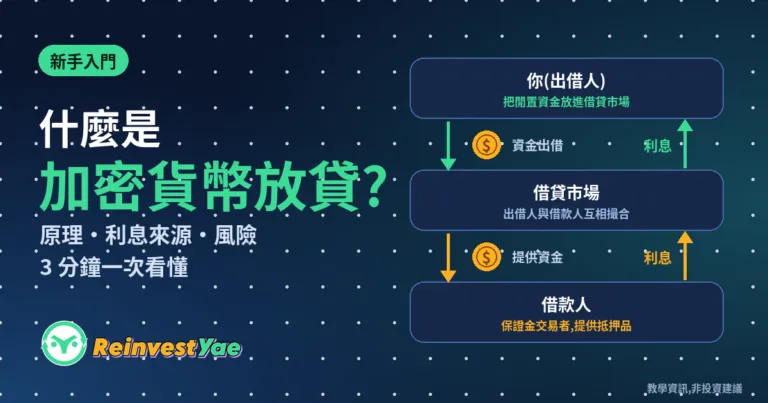
If you already know the basics ofCrypto lending(if not, start withNew to this? Start here: What Is Crypto Lending?), the next question is usually: how do you actually lend on Bitfinex? Bitfinex funding:what the funding wallet is, what you set when you place an offer, how to choose rates and terms, how interest and fees are calculated, and the risks that are specific to this platform.
A quick note: Bitfinex's rules and interface can change at any time. This article is compiled from Bitfinex's official information (October 2026). Please check Bitfinex's latest pages before you act.
Before You Start: What Does Your Account Need?
Two things need to be ready before you can lend on Bitfinex:
- Identity verification:According to Bitfinex, accounts created after March 1, 2022 need at least Intermediate-level verification to use funding. Review takes time, so it is best to do this early.
- Assets to lend:The funding market supports many currencies, including USD, stablecoins such as USDT, and BTC, ETH and others. Bitfinex states that USDT is the most popular currency for lending on its platform.
What Is the Funding Wallet, and How Is It Different from the Trading Wallet?
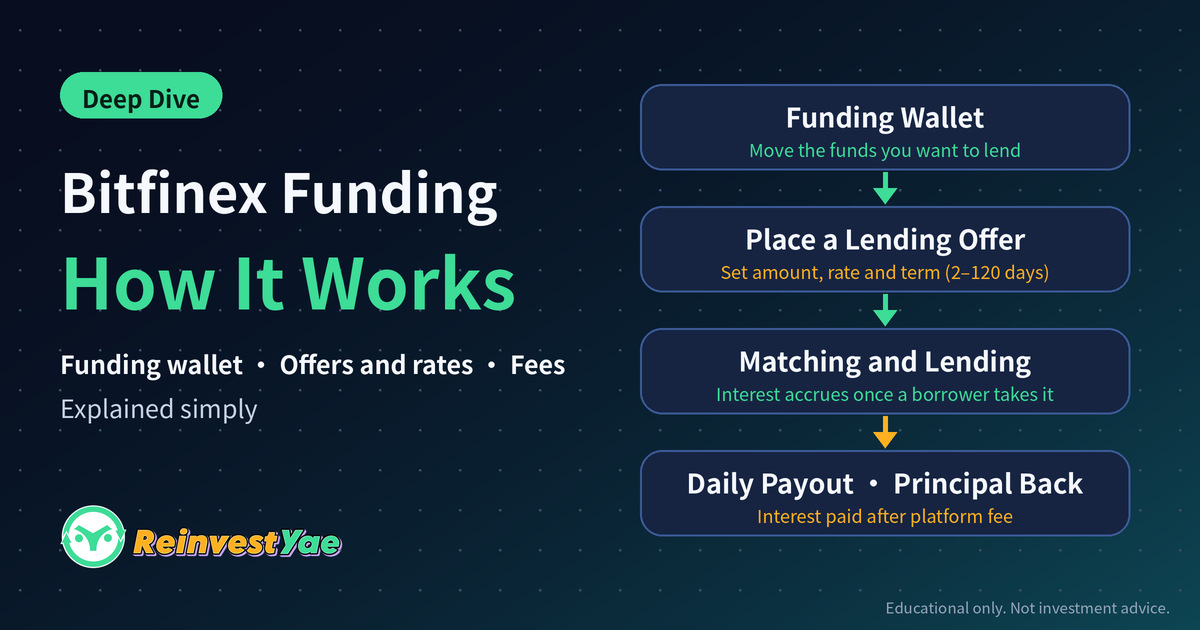
Bitfinex keeps your assets in different wallets for different purposes. Lending uses theFunding Wallet,which is dedicated to providing funds to the funding market. Funds in your Exchange or other wallets must be moved into the Funding Wallet before you can lend them.
- Moving funds in:Transfers between wallets inside Bitfinex are free and instant.
- While lent out:Funds stay in the Funding Wallet with a "lent out" status. You remain the owner of the asset.
- At maturity:Principal and interest return to the Funding Wallet. You can place a new offer, or move the funds to another wallet and withdraw.
For a step-by-step walkthrough with screenshots, follow theGuidesto move funds between wallets.
What Do You Set When You Place a Lending Offer?
On Bitfinex's funding page, you mainly decide four things:
- Amount: Each offer must be worth at least 150 USD.
- Rate: You can set a fixed rate yourself, or follow the market reference rate (FRR). More on this in the next section.
- Term: 2 to 120 days. The most common choices are 2, 7 and 30 days.
- Other options:For example, a "hidden offer" (not shown in the order book, with a higher fee) and whether to turn on auto-renew.
Bitfinex quotes rates as a daily rate. The platform also shows an annualized figure to make it easier to understand, but the annualized number is only a conversion, not a guaranteed return.
How to Choose a Rate: Fixed, FRR and FRR Delta
Bitfinex gives you several ways to set your rate:
- Fixed rate: You choose a daily rate, and your offer fills only if a borrower accepts it. A higher rate means a lower chance of filling; a lower rate fills faster but earns less interest per day.
- FRR (Flash Return Rate): A market reference rate Bitfinex calculates from the fixed-rate offers in the funding order book, weighted by amount. It updates once per hour. Lending at FRR means letting your rate follow the market instead of guessing.
- FRR Delta (FRR plus or minus an offset): You add or subtract an offset from FRR so your rate sits slightly above or below the market. According to Bitfinex, "Delta Variable" updates with FRR during the loan, while "Delta Fixed" becomes fixed once the offer is matched.
Whether your rate keeps changing after a match depends on the option you choose, so read the description on the order form when you place the offer. FRR itself is only a hypothetical reference rate. It is not a guaranteed return.
How to Choose a Lending Term
A longer term locks your funds for longer. A shorter term lets you re-place offers at the latest market rate sooner. Bitfinex itself notes that many lenders prefer short terms (for example 2 to 7 days) because they can update their rates more often and keep up with the market.
- Short terms: Funds turn over quickly and you can adjust rates often, but you need to re-place offers more often (auto-renew can help).
- Long terms: Less hands-on work, but once lent out the rate is fixed, so you will not benefit if market rates rise later, and your funds take longer to come back.
No term is "always better". It depends on when you might need the funds and how often you are willing to manage them.
How Are Offers Matched, and Why Do Some Not Fill?
An offer is not guaranteed to be lent out. According to Bitfinex, the funding market matches offers roughly like this:
- Lower-rate offers generally match first.
- Your term must be compatible with the term the borrower wants.
- Fixed-rate offers fill only if a borrower accepts the rate you set.
- An offer may be only partly filled, so your funds can be split across different borrowers.
When demand is quiet, or your rate is set higher than the market, your offer may sit unfilled for a while. That is how the market works, not a malfunction. Offers that have not filled can be cancelled or edited at any time.
How Is Interest Calculated, and What Are the Fees?
- Interest accrues by the second: Funds earn for as long as they are actually lent out. If a borrower repays early, you earn only for the time the funds were borrowed. Even if funds are returned in under an hour, Bitfinex credits a minimum of one hour of interest.
- Credited daily: According to Bitfinex, interest is credited at about 01:30 UTC each day (about 9:30 AM Taiwan time).
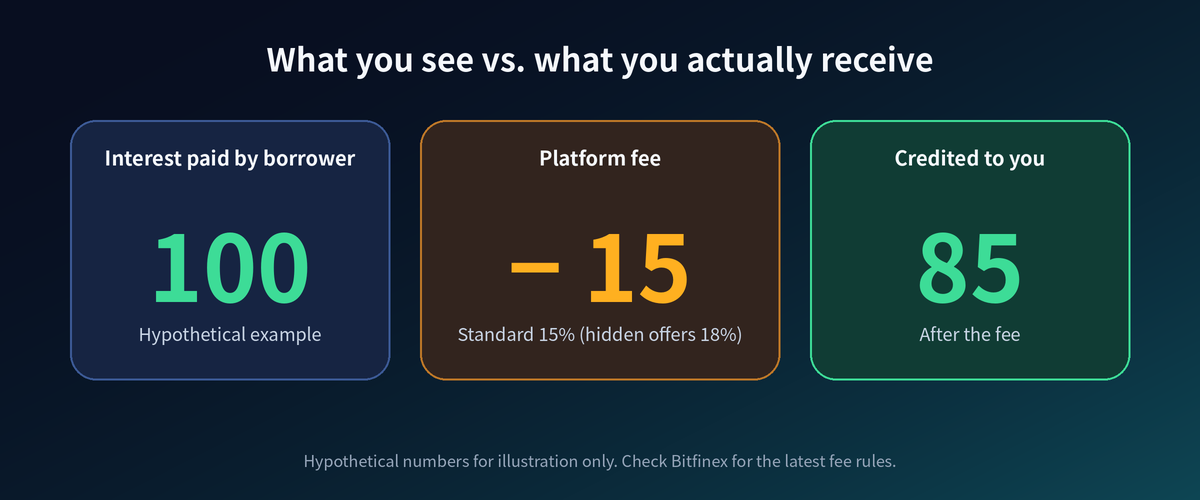
- Platform fee: Bitfinex charges a fee on lending earnings: 15% for standard offers and 18% for hidden offers. Holding UNUS SED LEO may give a fee discount. See Bitfinex's fee page for the current rules.
Here is a hypothetical example only to show how the calculation works: if a loan generates 100 units of interest in a day, after the 15% fee you receive 85 units. This is not a prediction of any earnings. It simply shows that between the rate you see and what you actually receive, there is a platform fee.
What Happens After Your Funds Are Lent Out?
- No early recall: You cannot cancel a loan once it is lent out. You wait until maturity, or until the borrower repays early.
- Borrowers can repay early: Your funds may come back sooner than expected, and interest is calculated on the actual time lent.
- Return to the Funding Wallet: Principal and accrued interest come back together, and you can place a new offer.
- Auto-renew: When turned on, funds that return to the Funding Wallet are automatically placed into a new offer using your previous settings, reducing idle time.
What Are the Risks of Bitfinex Funding, and How Can You Reduce Them?
Bitfinex has safeguards for lenders such as collateral requirements and automatic liquidation, but that does not mean there is no risk. Below, each risk comes with ways to reduce it. To be clear: these steps can lower risk, but they cannot remove it.
1. Platform risk
While you are lending, your funds stay on the exchange, so the platform's security, operations and withdrawal policies all affect your funds.
How to reduce it:
- Do not keep all your assets on one platform, and only put in an amount for which you accept platform risk.
- Follow platform announcements and official news, and pause new offers if you have concerns.
- Keep money you may need soon out of the Funding Wallet, or choose shorter terms so funds return sooner.
2. Extreme market risk
In sharp market moves, collateral and liquidation mechanisms may not be able to react in time. Even though the design aims to protect lenders first, it should not be treated as an absolute guarantee.
How to reduce it:
- Only use idle funds you can afford to put at risk, and keep part of your money out of lending. Never use money you need for living expenses.
- Invest in stages instead of all at once, and consider spreading larger amounts across currencies.
3. Opportunity cost and rate changes
If you lend at a fixed rate and market rates rise afterwards, you still wait until maturity to update. In the other direction, when rates fall, your offer may find no takers.
How to reduce it:
- Favor short terms (for example 2 to 7 days) so you can re-place offers at the latest rate, and use long terms for only a small share.
- Mix fixed rates with FRR so part of your lending follows the market.
- Turn on auto-renew or use an automation tool to reduce idle time.
4. No guaranteed returns, and offers may not fill
There is no deposit insurance. Rates are set by market demand, and offers can sit unfilled for a long time.
How to reduce it:
- Do not plan your finances around "fixed income", and do not count lending income as money you must have.
- Check market rate trends from time to time, and do not set your rate too far from the market.
5. Liquidity risk from locked funds
Once lent out, funds cannot be recalled early, so they are unavailable in the meantime.
How to reduce it:
- Before lending, think about the longest time you might need the money, and keep your term within it.
- Keep part of your funds out of lending as a reserve.
Operational and security risk:
Poorly protected account passwords, two-factor authentication or API keys can lead to losses.
How to reduce it:
- Turn on two-factor authentication for your Bitfinex account, use a strong password that is unique to Bitfinex.
- If you use a third-party tool, create the API key with only the permissions it needs (for lending, "Read" and "Margin Funding"), never enable withdrawal permission, and never share the key with anyone or post it publicly.
- When you stop using a tool, delete its API key in Bitfinex. If you notice anything unusual, disable it right away.
- Watch out for phishing sites and fake support, and always log in from the official address.
For more on how we approach fund safety, see oursecurity overview.The basic rule: only use money you can afford to put at risk and will not need soon
Manual Offers or an Automation Tool?
If you do all of the above by hand, you need to watch rates, choose terms, and re-place offers when loans mature. Bitfinex also supports connecting third-party tools through API keys, and many lenders use bots to reduce idle funds. Bitfinex also states that it does not endorse any third-party tool, that users must manage their own API permissions, and that it recommends enabling only the limited permissions you need.
ours ReinvestYae is this kind of tool: your funds stay in your own Bitfinex account, and the bot only uses "Read" and "Margin Funding" permissions to place offers. It has no withdrawal permission and does not guarantee any returns. To learn how it works, seeHow It Worksfollow theGuidesstep by step, orsign up for the free FREE plan,to try it first.
Frequently Asked Questions (FAQ)
Can I withdraw money from the Funding Wallet?
Funds that are not lent out can be: cancel the offer, move the funds from the Funding Wallet to another wallet, then withdraw. Funds that are already lent out come back only at maturity (or when the borrower repays early).
What is the minimum amount to lend on Bitfinex?
According to Bitfinex, each lending offer must be worth at least 150 USD. Check the order form for the current minimum.
What does FRR mean?
FRR (Flash Return Rate) is a market reference rate Bitfinex calculates from the fixed-rate offers in the funding order book, weighted by amount. It updates once per hour. It is a hypothetical reference figure, not a guaranteed return.
What are Bitfinex's lending fees?
According to Bitfinex, a fee is charged on lending earnings: 15% for standard offers and 18% for hidden offers, and holding UNUS SED LEO may give a discount. Lenders do not pay anything upfront when placing offers. The fee is deducted from the interest earned.
When is interest credited?
Interest accrues by the second and, according to Bitfinex, is credited at about 01:30 UTC each day, which is about 9:30 AM Taiwan time.
Can I cancel an offer after placing it?
Offers that have not filled can be cancelled or edited at any time. Funds that are already lent out cannot be recalled early by the lender.
Sources and Further Reading
The platform rules in this article are compiled from Bitfinex's official public information. For the latest details, read the originals:
- How to Earn with Margin Lending on Bitfinex(Bitfinex blog: the funding process and FAQ)
- Understanding Funding Terms(Bitfinex Help Center: FRR, FRR Delta, auto-renew and more)
- Bitfinex Fees(the latest funding fee and LEO discount rules)
Risk notice: This article is for education and information only. It is compiled from Bitfinex's public official information, and platform rules and interfaces may change at any time, so please rely on Bitfinex's latest official information. It is not investment advice and does not guarantee any returns. Crypto involves market, platform and operational risks. Please assess them carefully based on your own risk tolerance.